
April’s Birthstone: Diamond
If you were born in April, then your birthstone is the diamond, the undisputed heavyweight of the gem world. Renowned for its sheen and unmatched hardness, the diamond is a geological wonder, as much as it is a symbol of luxury.
Chemical Composition: The Power of Carbon
Compromised entirely of carbon, diamonds are the only gemstones that are made of a single element. Under extreme conditions, carbon atoms bond in a "cubic" crystal structure that is incredibly tight and stable. This unique structural pattern is what makes diamond the hardest natural substance on Earth, resulting in its ranking of a perfect 10 on the Mohs scale.
Forged in Fire: Earth-Grown vs. Lab-Grown
Each diamond’s conception is one of extreme transformation, regardless of whether it happens over eons or weeks.
Earth-grown: Natural diamonds form 100 miles below the surface in the Earth’s mantle. They then remain there for billions of years, until deep-seated volcanic eruptions blast them toward the surface.
In the Lab: Modern technology allows us to replicate this process, allowing us to grow diamonds atom-by-atom from a carbon-rich gas in a vacuum chamber. As a result, lab-grown diamonds are chemically and physically identical to those mined from the Earth itself.
A Glittering History & Cultural Significance
The name "diamond" comes from the Greek phrase “adamas,” meaning invincible or unconquerable. During the Middle Ages, diamonds were thought to have healing powers, capable of curing brain diseases or detoxifying the body.
The diamond's association with eternal love began in 1477, when Archduke Maximilian of Austria gave a diamond ring to Mary of Burgundy. However, it wasn't until the famous "A Diamond is Forever" campaign of the 1940s that led to their reputation as the "must-have" stone for engagements.
Symbolism: More Than Just Beauty
While we often associate diamonds with engagement rings, their symbolic roots are far deeper than modern romance. For those born in April, the diamond carries a spiritual and traditional meaning that has evolved over the course of millennia.
Purity and Spiritual Clarity
Because of their ability to bend light and their often colorless nature, diamonds have become a universal symbol for purity and innocence. In various spiritual traditions, diamonds are believed to possess an energy that can clear the mind of "fog" or confusion. As a result, they are often used in meditation to represent clarity of thought and the removal of emotional blockages. If you are facing a crossroads in life, the April birthstone is said to help you see your path with "crystal clear" focus.
Eternal Love and Fidelity
The diamond’s "eternal" nature makes it the perfect metaphor for a bond that never breaks. This is why it remains the standard for 60th and 75th wedding anniversaries. It symbolizes a love that has survived the "weathering" of decades, proving that the relationship is unbreakable, much like the stone itself.
Enlightenment and "The Divine Spark"
In Eastern philosophies, the diamond is sometimes associated with the "Vajra," which represents a type of spiritual enlightenment that is powerful enough to cut through ignorance. Many cultures viewed the "fire" or "sparkle" inside the stone as a trapped piece of a star or a fallen drop of dew, symbolizing a connection to the divine.
Prosperity and Abundance
Throughout history, the rarity and beauty of diamonds have made them a symbol of status and wealth. However, in a more modern sense, they are often seen as "magnifiers." It is believed that a diamond can amplify the energy of the wearer, resulting in an abundance of positive traits like courage, creativity, and joy.
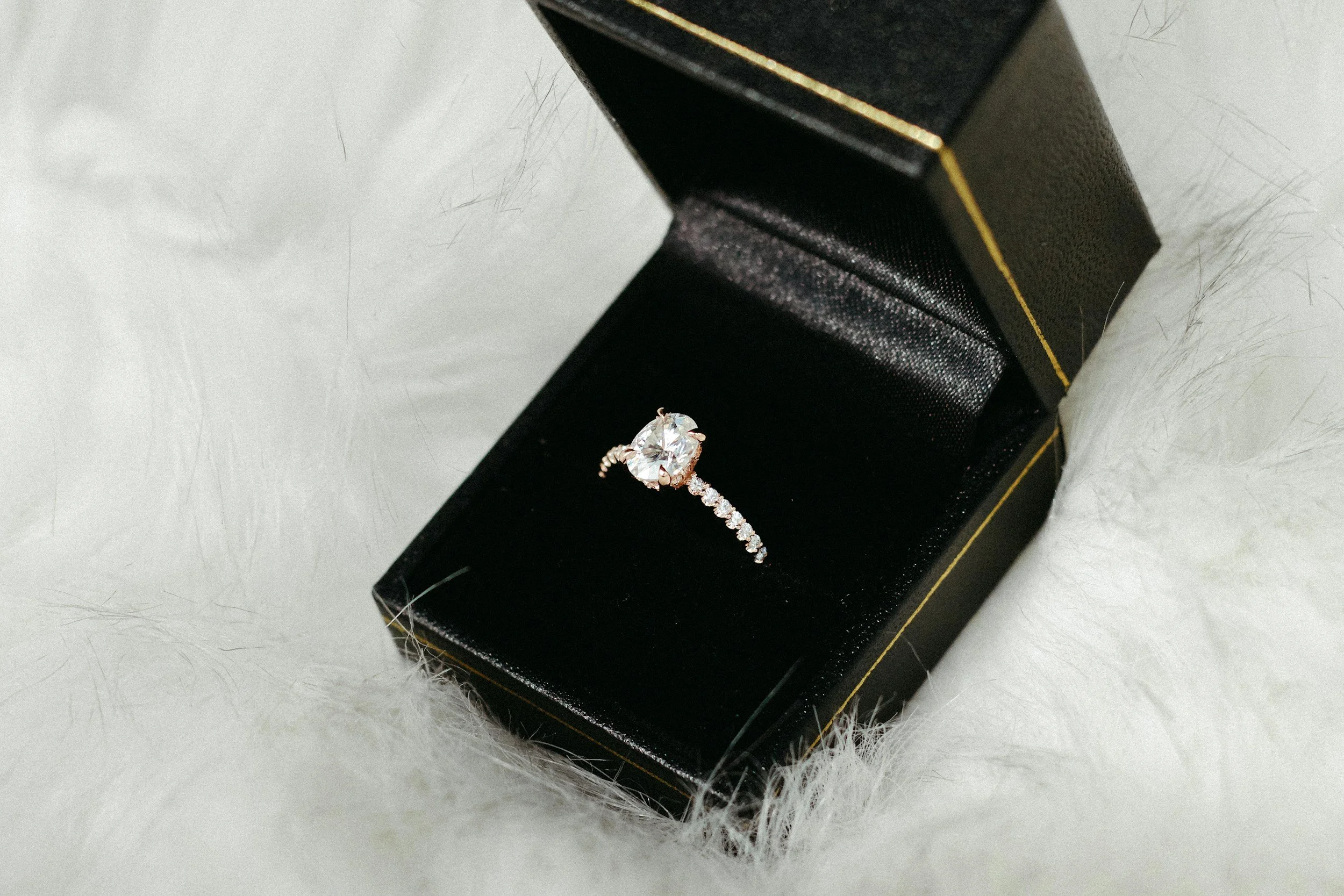
Diamonds are often used for engagement and wedding bands
The Universal Language: Understanding the 4Cs
When you’re looking to buy or design diamond jewelry, you’ll constantly hear about the 4Cs. Developed by the Gemological Institute of America, these measures have become the global standard for judging diamond quality. Understanding these four factors is the secret to getting the most beauty for your budget.
1. Cut (The Most Important “C”)
The cut doesn’t relate to the shape but how well the diamond’s facets interact with light. A well-cut diamond acts like a series of mirrors, reflecting light back to your eye.
Ideal/Excellent: Maximum sparkle and "fire."
Poor: Light "leaks" out the bottom or sides, making the diamond look dull or dark.
Pro Tip: If you want that classic "room-stopping" sparkle, never skimp on the cut!
2. Color (The Absence of Tint)
In white diamonds, the "best" color is actually a total lack of color. The scale runs from D (Colorless) to Z (Light Yellow or Brown).
D-F: Completely colorless to the naked eye (and the most expensive).
G-J: "Near colorless." These look white to most people but offer much better value.
Pro Tip: If you are setting your diamond in yellow or rose gold, you can often go lower on the color scale (like a K or L) because the metal’s warmth hides any slight tint in the stone.
3. Clarity (The Story of Its Birth)
Natural diamonds formed deep in the Earth often trap tiny bits of other minerals or fractures inside. These are called inclusions.
FL/IF: Flawless; no imperfections even under 10x magnification.
VS1/VS2: "Very Slightly Included." You usually need a microscope to see anything.
SI1/SI2: "Slightly Included." These are often "eye-clean," meaning you can't see the flaws with just your eyes, making them a "sweet spot" for value.
Pro Tip: Look for "eye-clean" diamonds to save money without sacrificing the look of the stone.
4. Carat (The Weight)
Carat refers to the diamond's physical weight, not its visual size. Because large diamonds are much rarer in nature than small ones, the price jumps significantly at "magic numbers" like 1.00ct or 2.00ct.
Pro Tip: To save money, look for "under-sizes." A 0.90-carat diamond will look almost identical to a 1.00-carat stone but can cost significantly less because it hasn't hit that "magic" weight threshold.
Designing Custom Diamond Jewelry
Creating a custom piece is the ultimate way to celebrate an April birthday. Here’s how the process usually goes:
Select Your Stone (The 4Cs): You’ll balance Cut (how it sparkles), Color (how white it is), Clarity (how clean it is), and Carat (the size).
Choose Your Metal: Platinum and White Gold are popular for a seamless, icy look. Yellow Gold provides a classic, high-contrast warmth, while Rose Gold offers a romantic, modern feel.
The Setting: This is where the magic happens. A Solitaire is timeless; a Halo makes the center stone look larger; and a Bezel setting surrounds the stone in metal for a sleek, secure, and modern look.
The Details: Add "hidden" elements like an engraving inside the band or a small "peek-a-boo" birthstone underneath the main setting to make it truly yours.
To bring your vision to life, there is no better partner than the experts at Seattle Jewelry Design and Repair, where local craftsmanship and years of expertise come together to help you create a custom diamond masterpiece that will last a lifetime.

Hey there, I’m Nina!
I’m a Seattle-based jeweler specializing in custom designs, heirloom restorations, and thoughtful repairs, all done by hand, start to finish, right here in my studio. Every piece I work on carries a story, and I take pride in preserving that story through craftsmanship, care, and attention to detail.
Whether you’re dreaming up a one-of-a-kind creation, bringing new life to a family treasure, or simply fixing a favorite everyday piece, my goal is to make the experience personal, collaborative, and meaningful.
If you have an idea, or even just a feeling, about what you want, let’s bring it to life together.
